


On August 4, Michigan Democrats will pick a U.S. Senate nominee and decide the fate of one of the state’s most contested House seats. In both races, the same outside force is spending to determine the outcome: the pro-Israel lobby, led by the American Israel Public Affairs Committee and its super PAC, United Democracy Project (UDP).
AIPAC and its allied groups, including Democratic Majority for Israel (DMFI), poured more than $100 million into the 2024 cycle alone, making the network the single largest outside spender in Democratic primaries. Michigan is a decade-long case study in how that money moves, who it rewards, and what it teaches candidates about which positions are survivable.
The Senate Race: Haley Stevens and the Untraceable Millions
In the Senate primary, Haley Stevens is running against progressive Abdul El-Sayed. A third candidate, state Sen. Mallory McMorrow, ended her campaign in mid-July, turning the race into a direct two-way contest between the party’s establishment wing and its progressive insurgency, with AIPAC’s money planted squarely on one side of that divide. UDP announced a $2 million ad buy in June boosting Stevens, built around her record on the auto industry and prescription costs, not Israel.
That’s the visible spending.
A Detroit News analysis of campaign finance filings found that a large share of Stevens’ donor base traces back to AIPAC, even though the group’s name shows up nowhere in her disclosures. AIPAC has historically bundled donations and spent openly for Stevens, including more than $5 million combined in 2022. This cycle, its contributions are being routed through a payment processor called Democracy Engine, which doesn’t list AIPAC among its disclosed partners. Money with a clear political origin becomes functionally untraceable to an ordinary voter reading an FEC report.

AIPAC has engineered a Stevens victory over a more progressive Michigan Democrat before. In the 2022 redistricting cycle, AIPAC poured millions into defeating then-Rep. Andy Levin, a progressive former synagogue president and self-described Zionist who was nonetheless a vocal defender of Palestinian rights. Levin lost his primary to Stevens, who has consistently backed continued U.S. military support for Israel’s operations in Gaza. Supporting Israel’s existence, or even calling yourself a Zionist, was never the bar. Silence on Palestinian rights was. AIPAC will spend against any Democrat, however pro-Israel, who won’t offer it.
The spending has only grown as the primary narrowed to two candidates. By July 1, ad reservations tracked by AdImpact Politics showed $34.4 million backing Stevens against just $2.8 million for El-Sayed. By mid-July, outside groups backing Stevens had plowed more than $50 million total into the race, while El-Sayed, who has refused corporate PAC money entirely, had seen less than $1 million in outside advertising support of his own. UDP alone has spent more than $10 million boosting Stevens, a candidate the group has backed since it helped elect her in 2018 and reelect her in 2022.
A statewide poll released in mid-July found that roughly half of likely Michigan Democratic primary voters view AIPAC unfavorably, a striking number for a group most voters can’t itemize in a campaign finance report, precisely because it’s designed not to show up in one.
The Cost of Refusing AIPAC
Stevens’ side of the ledger shows AIPAC’s money hiding in plain sight. El-Sayed’s shows what happens to a candidate who refuses to play along. He is the only candidate in the race who has never met with AIPAC or sought its support, and the group has called him “a direct threat to the US-Israel relationship” over his opposition to unconditional U.S. aid. In late June, after eight consecutive polls showed El-Sayed leading the race, UDP launched a $2 million ad buy attacking his “long history of disrespecting women,” built around a discrimination lawsuit he wasn’t even named as a defendant in and misrepresentations of old comments about the efficacy of Michelle Obama’s health initiatives and Gov. Gretchen Whitmer. The ad never mentions Israel, aid policy, or the actual reason the group is spending against him.
El-Sayed has called AIPAC’s spending against him a form of legalized bribery, arguing that Stevens is more committed to a foreign country’s future than to funding schools and healthcare at home. In a televised debate, he said AIPAC has spent tens of millions of dollars on attack ads against him, or ads lying about his opponent’s record, because he represents, in the group’s own framing, the most dangerous candidate to the US-Israel relationship in the race. His campaign has accused AIPAC-backed groups of flooding the airwaves with misleading ads as spending against him has climbed past $50 million, and pushed back with a homegrown ad featuring his grandparents rather than the outside money his opponent enjoys.
The pro-Stevens messaging has strayed into misleading territory too. One AIPAC-funded ad runs footage of Barack Obama to imply a level of association or endorsement the former president has never actually given Stevens in this race. Same tactic as the ads that skip past Israel entirely: borrow credibility, or manufacture a scandal, from anywhere except the actual policy question the money exists to protect.
MI-13: The Reward for Reversal
Detroit’s 13th District tells a similar story from a different angle. Rep. Shri Thanedar is being challenged by state Rep. Donavan McKinney, who has been endorsed by Justice Democrats, Rashida Tlaib, and Bernie Sanders, in a primary widely understood, including by national reporters covering it, as a proxy fight over the US-Israeli relationship in the midst of a genocide in Gaza and ethnic cleansing in the West Bank.
Thanedar wasn’t always the lobby’s candidate. As a state legislator, he co-sponsored a resolution describing Israel as an apartheid state and was critical of the Israeli government. After entering Congress, he reversed course and became one of the House’s most reliable pro-Israel votes. AIPAC’s money followed.
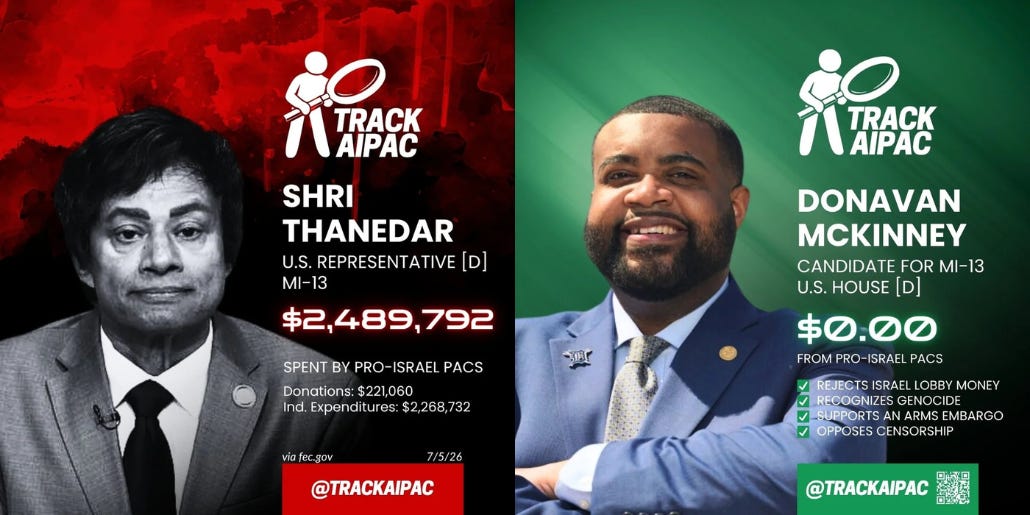
Reporting this month found that roughly two-thirds of Thanedar’s campaign cash has come through AIPAC-linked channels, even as he lost more than $600,000 on campaign funds he’d diverted into cryptocurrency investments. A Justice Democrats spokesperson described MI-13 as one of the poorest districts in the country and argued that deep-pocketed donors get a return when a member votes with the funders on Israel and crypto policy while remaining unreachable to constituents.
MI-13 runs through Highland Park and swaths of Detroit. It remains one of the poorest congressional districts in the country. AIPAC exists to advance a foreign government’s interests in U.S. policy, and its electoral spending has tracked the Israeli right rather than any consistent partisan line in American politics. The group has backed and defended Republicans who voted against certifying the 2020 election, a fact Hollier himself waved off in 2022 by noting AIPAC “supports people based on one issue.” In Michigan, that single-issue loyalty has meant channeling money toward whichever candidate, centrist or extreme right, is most reliable on Israel policy, and away from progressives in districts like MI-13 who campaign on redistributing resources toward housing, jobs, and public services in some of the poorest communities in the country. The lobby doesn’t have to oppose those priorities directly. It just has to make sure the candidates who champion them can’t afford to compete.
Michigan is one front in a strategy AIPAC has run against progressive Democrats nationwide. In 2022, UDP and its allied PACs spent more than $7 million combined to defeat Ohio state Sen. Nina Turner, a Squad-aligned progressive, in her primary. Two years later, the group spent $15 million unseating Rep. Jamaal Bowman in New York and $8.5 million defeating Rep. Cori Bush in Missouri, both replaced by self-described “pro-Israel” centrists. Rep. Donna Edwards lost a Maryland primary the same cycle after UDP spent more than $4 million against her. In every case, the candidate on the receiving end of AIPAC’s money stood to the left of the candidate it opposed on labor, on housing, on Medicare for All, not just on Israel. AIPAC entered the 2024 cycle with a stated goal of spending $100 million specifically to defeat progressives it viewed as insufficiently supportive of Israel.
AIPAC has also endorsed more than 200 Republicans for office, including 109 members of Congress who voted to overturn the 2020 election results. A former Justice Democrats spokesperson put it directly: AIPAC has exposed itself as the right-wing organization it is. AIPAC doesn’t just avoid mentioning Israel in its ads or route its money through opaque payment processors. It uses that money to push the Democratic Party’s primaries rightward, defeating its most progressive candidates while funding and defending extremist Republicans.
Ads About Everything But Israel
UDP’s Stevens ad buy runs on auto jobs and prescription costs instead of foreign policy because that’s the group’s standard playbook. When UDP spent nearly $2 million attacking Rep. Tom Malinowski, a Democrat who supports Israel but wouldn’t rule out conditioning U.S. aid to it, the ads never mentioned Israel, hammering him instead on unrelated votes. The same pattern shows up in Illinois, where UDP’s advertising has focused on domestic issues voters are already paying attention to, like immigration, while staying silent on the actual reason for the spending. The Nation’s reporting on AIPAC’s electoral operation found that not a single AIPAC or DMFI ad mentions Israel, because the groups know voters don’t rank the U.S.-Israel relationship as a top issue and would rather attack candidates on other grounds, sometimes stretching the truth to do it.
UDP’s own name was built to obscure its purpose. When AIPAC launched the super PAC in 2022, its mission statement didn’t mention Israel or AIPAC, talking instead about strengthening democracy. Asked directly why the group wouldn’t say what it actually supports, an AIPAC spokesman declined to give a straight answer. UDP’s own CEO told Jewish Insider that the issues the group runs ads on are simply “the issues that are foremost on the minds of voters.” The group has found it more effective to persuade voters on grounds it never has to defend.
A voter watching a UDP-funded ad about the auto industry or ICE, or one implying a Barack Obama endorsement that was never given, has no way of knowing the money behind it exists to protect one policy position, and only that position.
What's Actually at Stake
Leading human rights organizations, including Amnesty International, B’Tselem, and Human Rights Watch, have documented Israel’s system of control over Palestinians as apartheid. The International Court of Justice found in a provisional ruling that South Africa’s genocide claim against Israel was plausible, ordering Israel to take measures to prevent genocidal acts in Gaza. AIPAC exists to insulate the American politicians who fund and arm that conduct from any electoral consequence for it.

A foreign government’s interests, advanced through a nominally domestic lobby, are spending tens of millions of dollars to decide which Americans get to represent other Americans in Congress. A fossil fuel super PAC or a pharmaceutical trade group narrowing a primary’s acceptable positions is its own problem. AIPAC’s Michigan operation is worse on three counts: the single issue is a foreign government’s standing, the stakes are apartheid and mass civilian death, and the effect, coordinated with Jerusalem or not, is to subordinate the independence of American elections to the preferences of a foreign state.
Voters in the 13th District and across Michigan will decide these primaries in two weeks. Whatever they decide, the amount of money required to be a viable Democratic candidate in these races, and where a meaningful share of it can be traced if you look hard enough, is itself a story about how much say ordinary voters actually have left.