


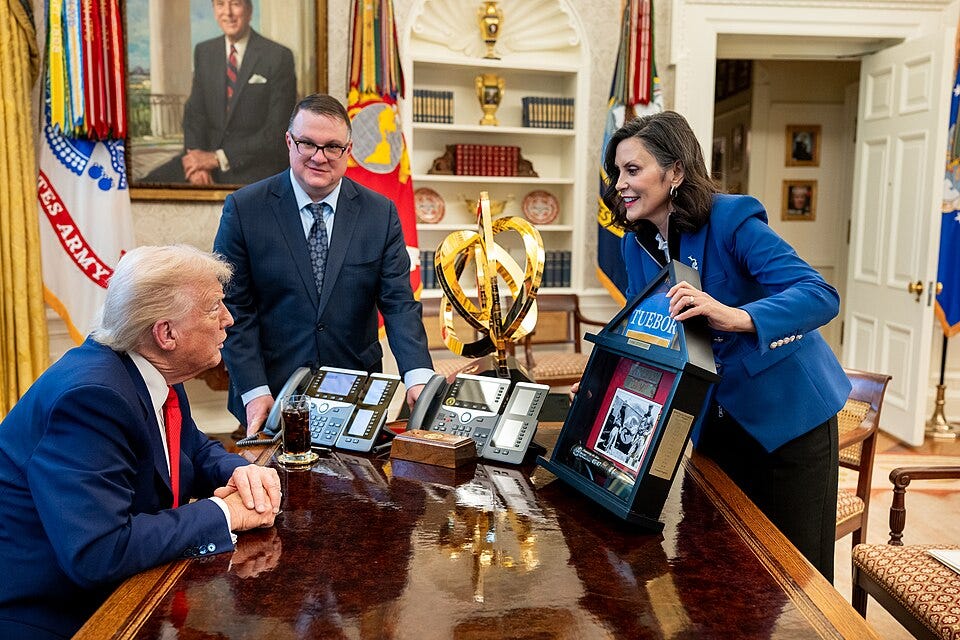
This came in fast. Friday afternoon, Whitmer endorsed Haley Stevens over Abdul El-Sayed, less than two weeks before the August 4 primary, after hundreds of thousands of Michiganders had already voted. She flew to Detroit to repeat the endorsement in person at a Teamsters hall, telling the crowd Stevens has “what it takes to win.” What it takes, apparently, includes close to $30 million in outside spending from AIPAC, a track record of opposing gig workers’ right to organize, and a refusal to touch anything resembling Medicare for All. El-Sayed’s campaign called it what it was: “The corporate establishment has closed ranks and made their pick.”
Whitmer built a national brand on the appearance of fighting for ordinary people, the Great Lakes, working families, communities of color. Scratch any one of those commitments and you find a governor who reliably chooses the institutional, well-funded, low-conflict path, then wraps the choice in the language of pragmatism. The Stevens endorsement is this week’s data point in a pattern that’s been running for eight years.
The Pattern Repeats down the Ballot: She Keeps Picking the Corporate Money
Zoom out from the Senate race and the same choice shows up in nearly every contested Democratic primary Whitmer has waded into this cycle. In each case, there was a candidate in the race who had pledged not to take corporate PAC money, and in each case, Whitmer endorsed the opponent who does.
In the Senate primary, it’s Stevens over El-Sayed. Stevens has accepted corporate PAC donations during this campaign from Google, Goldman Sachs and Cigna, and over her career corporate PACs have contributed at least $1.6 million to Stevens’ campaign accounts and $139,500 to her leadership PAC across her five runs for office, while El-Sayed has sworn off the category entirely.
In the open MI-11 seat being vacated by Stevens, it’s Jeremy Moss over both Don Ufford and Aisha Farooqi. Ufford’s campaign has been the only major candidate in the race refusing contributions from corporate PACs, while accusing Moss of accepting hundreds of thousands of dollars from corporate political action committees, utility PACs and AIPAC’s donor network, including $55,000 routed through the Better Blue Fund, a joint fundraising vehicle whose structure allows multiple candidates to raise funds collectively and attract larger contributions from wealthy donors, obscuring the political interests behind the money. Whitmer endorsed Moss in November 2025, months before any of this reporting came out, giving her chosen candidate a fundraising and institutional head start the corporate-money-refusing opponent never had a chance to compete with.
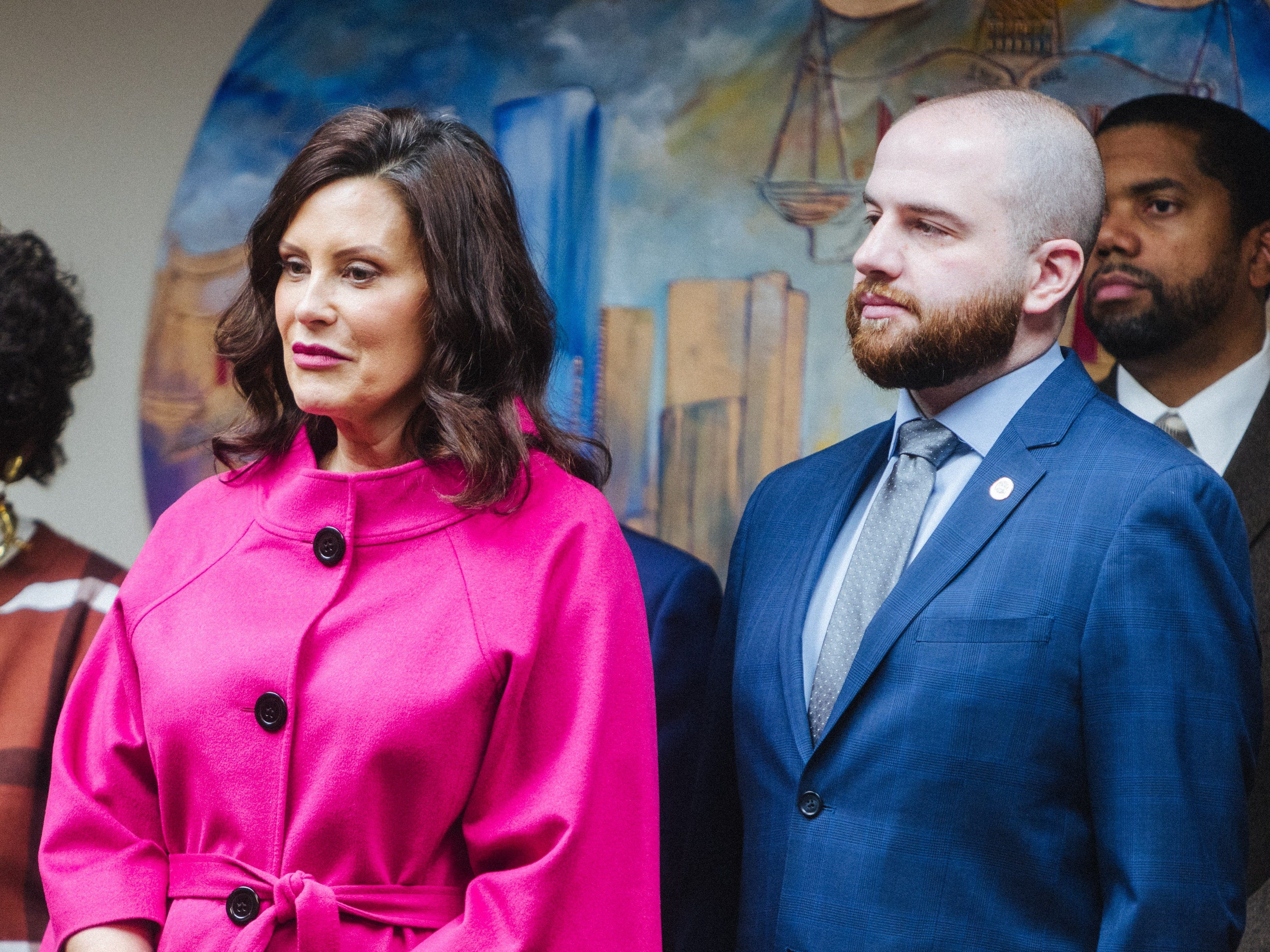
In the open Detroit-area Senate District 3 seat, it’s Korey Hall over Eboni Taylor. Hall is a sitting member of Whitmer’s administration, Detroit office director in the governor’s office, and she endorsed him directly: “I’m Big Gretch and I’m standing tall with Korey Hall.” Taylor, by contrast, shared a stage with El-Sayed, Bernie Sanders, and AOC at a Detroit rally rebuking corporate PAC money, the same rally where Rashida Tlaib campaigned for Donavan McKinney against Shri Thanedar in MI-13, another race built around the exact same corporate-money dividing line.
In the Ann Arbor mayor’s race, it’s Christopher Taylor over Yousef Rabhi. Taylor is a former corporate and commercial attorney running as the establishment incumbent; Rabhi, a DSA member, told a candidate forum he’d always worked against dark-money accounts and has not taken corporate PAC money, while accusing Taylor’s camp of being behind attack mailers funded by a dark-money group called Michigan Deserves Better.
And in Detroit’s House District 8, it’s Helena Scott over Chris Gilmer-Hill. Gilmer-Hill, an environmental justice policy expert endorsed by Rashida Tlaib, has pledged to never take money from AIPAC, DTE, Blue Cross/Blue Shield, or any other corporate or conservative PAC. Scott chairs the House Energy, Communications, and Technology Committee, the committee with direct oversight of DTE and Consumers Energy. She has taken DTE PAC money since the February 2023 outage crisis that put her committee in the spotlight in the first place, one of 13 of 17 energy committee members who kept accepting utility PAC checks even as they held hearings promising accountability.
Line 5: The Reversal She’s Still Trying Not to Call a Reversal
Nine days before the Stevens endorsement, EGLE and the DNR, both under Whitmer, approved the wetlands and submerged-lands permits Enbridge needs to build its Line 5 tunnel under the Straits of Mackinac. This is the pipeline she built her 2018 campaign around shutting down. The National Wildlife Federation’s response was blunt: the decision is a staggering reversal from Whitmer’s own administration’s previous efforts to shut down the pipeline and protect the Great Lakes. Michigan LCV was harsher: Whitmer had the opportunity to put the health and safety of the Great Lakes first, but instead backtracked on a promise and approved a dangerous project that threatens drinking water for millions of people.
The permitting documents themselves concede the project has significant impacts. The agencies concluded the project’s benefits outweigh those impacts and issued the permits anyway, while environmental advocacy organizations argued the governor had softened her stance after pledging in her 2018 campaign to take action against Line 5. Tribal governments, whose treaty rights and sacred sites sit directly in the path of this project, have opposed it consistently. The administration didn’t even bother responding to reporters asking for comment.
Nine Bills, One Signature Away, All Vetoed
Two weeks ago, after unions spent eighteen months in court forcing a Republican-controlled House to transmit nine already-passed bills to her desk, Whitmer vetoed all nine. These weren’t symbolic messaging bills. They included reforms to the 80/20 law restricting public-sector bargaining over health benefits, pension improvements for state and prison workers, and protections against garnishing unemployment and disability benefits. The joint statement from the Michigan AFL-CIO, UAW, and Michigan Education Association didn’t mince words: the veto betrays democratic values and abandons the very people who have supported her in office, calling it an insult to every hard-working Michigander fighting for economic justice.
Her stated reason was a technicality about effective dates. Even labor allies weren’t buying that the “overripe” framing required killing all nine outright rather than working with the legislature on a fix. Jocelyn Benson, running to succeed her, said what a lot of Democrats were thinking privately: teachers, nurses, corrections officers, and so many others spent years fighting for relief, only to have leaders they trusted pull the rug out from underneath them.
The Data Center Pledge: A Press Release in Place of Real Policy
Last week’s data center rollout is the clearest specimen of the genre. Facing pressure from a growing coalition demanding a moratorium until real regulations exist, Whitmer announced the “Michigan Affordability and Responsible Growth Pledge,” ten voluntary commitments asking data center companies to promise, on their own honor, not to pass costs onto ratepayers. Google and Oracle signed immediately and issued grateful statements. Of course they did. It costs them nothing.
Sierra Club Michigan’s Tim Minotas said what should be obvious: pledges and promises are not enough, and Michigan needs strong, enforceable data center regulations now. He put it even more plainly elsewhere: voluntary corporate promises are not a substitute for enforceable law, and Michigan should not have to rely on companies to regulate themselves. A moratorium was never on the table. What Whitmer offered instead was a menu of commitments with no enforcement mechanism and no penalty for noncompliance. Meanwhile a real regulatory package from Senate Democrats and a moratorium bill both sit stalled in Lansing, and she hasn’t pushed either one across the finish line.
The Data Center Subsidy That came Before the Pledge
The voluntary pledge didn’t happen in a vacuum. Before Whitmer ever asked data center companies to sign a promise, she signed them a tax exemption. On December 31, 2024, she approved Senate Bill 237, exempting operators that invest $250 million or more on digital infrastructure from sales and use taxes on equipment until at least 2050, alongside its House companion. House Bill 4906 and Senate Bill 237 exempt qualifying “enterprise” data centers from the state’s 6% sales and use tax on equipment through at least 2050, or 2065 if the facility is built on a brownfield site. That’s the actual policy substrate underneath every subsequent “protecting Michiganders from data center costs” press release. The state had already forgone hundreds of millions in tax revenue from the exact same companies before asking them to pledge, on their honor, not to pass their infrastructure costs onto ratepayers.
The vote itself split her party. Some Senate Democrats warned the timing was tone-deaf: Democrats had just come off a “tough election cycle” and should work to address resident concerns about high prices rather than write tax breaks for California-based tech companies, one legislator argued, saying no voter had ever asked for more corporate tax breaks. Environmental advocates raised the same objection they’d raise again a year later about the pledge: amendments to address water sourcing, ratepayer protection, and renewable energy requirements were included, but advocates argued the provisions were insufficient to fully protect Michigan’s environmental and economic interests while handing millions to some of the wealthiest corporations in the world. Michigan LCV didn’t equivocate in its scorecard: Whitmer prioritized corporate tax breaks over environmental and consumer protections, at a moment when other states are already seeing data center energy demand translate into rate hikes for ordinary customers and new fossil fuel buildout.
MPSC: Swap the Advocate for the Industry-Friendly Staffer
If you want the mechanism by which “pro-environment” governance quietly becomes pro-utility governance, look at who Whitmer puts on the body that actually sets DTE and Consumers’ rates. Last summer she declined to reappoint Alessandra Carreon, a commissioner viewed as too strong a clean energy and consumer advocate, and installed Shaquila Myers, a former senior adviser on her staff, in her place. A Michigan Advance source described it without euphemism: that was the governor’s very deliberate choice.
This landed while DTE Energy’s $574.1 million rate hike proposal aimed to boost infrastructure and clean energy, raising Michigan residents’ bills by $13.50 monthly, with Attorney General Dana Nessel among the critics demanding proof the expenses and rates were fair and justified. And it’s worth knowing the financial backdrop: Michigan Energy First, a nonprofit group tied to DTE, gave $750,000 in 2022 to Road to Michigan’s Future, a nonprofit linked to Whitmer.
Fighting to Keep Detroit “in Attainment,” Against the Actual Air

This is the one that should make people the angriest, because it directly touches public health in the communities Whitmer’s rhetoric claims to prioritize. Southeast Michigan has had an ozone problem for years, concentrated in neighborhoods like the one around the East 7 Mile monitor, which carries one of the highest asthma hospitalization rates in the state. Rather than accept nonattainment status, which would trigger real pollution controls, mandatory vehicle inspections, and tighter permitting for industrial sources, the Whitmer administration has spent years trying to argue the numbers away.
Whitmer’s administration argued wildfires caused the high ozone readings at the East 7 Mile monitor, and after the EPA accepted that argument and discounted the data, it found southeast Michigan in attainment, letting EGLE avoid measures like requiring vehicle emissions testing. A federal appeals court eventually ruled this was unlawful: the Sixth Circuit overturned the EPA’s decision, citing Michigan’s failure to enforce regulations on industrial facilities emitting the pollutants that create ozone. Rather than take the hint, EGLE went back to the EPA seeking another wildfire smoke exemption to argue for ozone compliance, even as monitoring data showed the problem getting worse, not better, with additional monitors creeping above the ozone standard at Oak Park and Port Huron for the first time in 2025.
Unprecedented Levels of Corporate Welfare
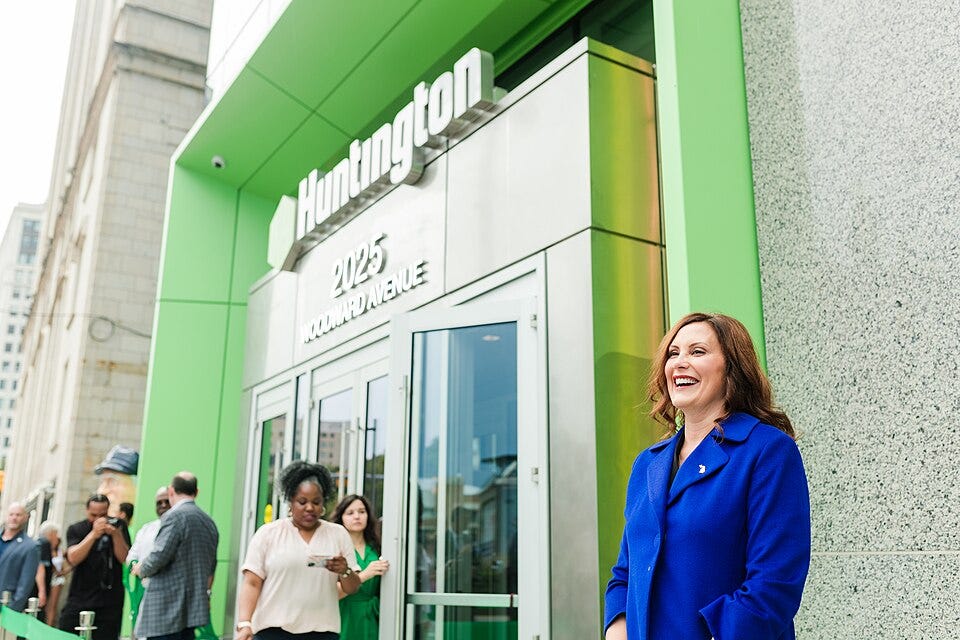
None of this is offset by some parallel record of successful public investment. Under Whitmer’s SOAR fund, companies received nearly $1 billion from the state through SOAR and other corporate subsidy agreements that promised to create 65,491 jobs, and so far they have created 13,079. That’s roughly one job created for every five promised, at a cost approaching six figures per job actually delivered. Lawmakers in both parties eventually killed the fund’s ongoing budget authorization. Even the belated 2025 hiring wave only reached 1,846 of the 14,559 new jobs various firms promised, less than 13% of what companies had committed to create in exchange for $1.74 billion in taxpayer subsidies.
The Pockets Lined to “Fix the Damn Roads”
The slogan that made her in 2018 finally became a real deal last October, when Whitmer and House Speaker Matt Hall signed off on a plan to pump as much as $2 billion a year into road repairs, the largest funding increase for roads in state history. Whitmer called it the fulfillment of her signature campaign promise. What she didn’t mention was what happened at a steakhouse in Birmingham seven weeks before the ink dried.
On August 21, 2025, a slew of road construction executives whose companies stood to benefit from the spending gathered at Fleming’s Steakhouse and wrote checks totaling $211,293 to Hall’s leadership PAC in a single day, most of them $4,000 or more. It was more money than any legislator’s leadership PAC had raised in total through the prior nine months. Road-building company donations more than doubled statewide in 2025 compared to the year before, an odd-numbered, non-election year when giving normally drops off, jumping from roughly $204,000 in all of 2024 to more than $400,000 by October, timed almost exactly to the window when Hall and Whitmer were negotiating the deal behind closed doors. The industry’s trade group, the Michigan Infrastructure and Transportation Association, gave another $268,000 directly to legislators and PACs through the same stretch, on top of what individual executives gave.
Five members of the family that founded lane-painting firm PK Contracting gave a combined $20,000 at the fundraiser. The parent company of Michigan Paving and Materials contributed $8,000 days after that firm’s operations manager attended in person. Former Detroit Mayor Mike Duggan, running for governor as an independent, pulled in more than $80,000 from road-industry donors during the same window.
None of this is illegal, and Michigan’s own campaign finance watchdog was careful to say the deal’s structure can’t be traced cleanly back to any single donor’s wish list, since the real negotiations happened behind closed doors where no public record shows who asked for what. But the watchdog also didn’t pretend the optics were nothing. Neil Thanedar, executive director of the Michigan Campaign Finance Network, put it plainly: when political leaders raise hundreds of thousands of dollars from industry executives a month before delivering billions in new funding for that same industry, it leads the public to assume tax money is being lost to corruption, whether or not any single transaction is ever proven to be one.
The deal itself did nothing to close the door on that assumption going forward. The nonpartisan Citizens Research Council reviewed the final package and called the funding changes “haphazard and not well thought-out,” noting lawmakers made no structural reforms to how road money gets awarded. The biggest structural shift, routing roughly 60% of new funds to county and municipal road agencies instead of the state, sounds like decentralization until you notice that local road contracts are handed out with far less competitive bidding and far less oversight than state-level ones. Only 23 of Michigan’s 83 counties even participate in the state’s open bidding network. A researcher who studies the program for the Council didn’t mince words: if you want to find waste, fraud, and abuse in Michigan government, don’t ignore road construction. Whitmer signed the bill anyway, took the ceremonial photo in the hard hat and vest, and called it a promise kept. It probably was, for the people who own the companies that were writing checks at Fleming’s the same fall it passed.
Slipping $250,000 Donations Through a Loophole
Long before any of this cycle’s endorsements, Whitmer ran a version of the corporate-money playbook herself, and it’s worth remembering because it shows the instinct isn’t new. Michigan caps individual donations to a gubernatorial campaign at $7,150. In 2021, facing a wave of pandemic-era recall petitions, Whitmer’s campaign invoked a 1984 state ruling that lifts contribution limits entirely for officeholders defending against an active recall. Only one of the roughly 30 recall efforts filed against her ever actually produced a recall committee. She used the exception anyway, and kept using it for the better part of a year.
The money that flowed in dwarfed anything her limit-abiding opponents could touch. Mark Bernstein, a personal injury attorney and University of Michigan regent, gave $257,150. Illinois Gov. J.B. Pritzker gave $250,000. Ronda Stryker, Patricia Stryker, and Samson Energy executive Stacy Schusterman each gave the same quarter-million. By the Michigan Freedom Fund’s count, at least $3.8 million of the $14.2 million Whitmer raised in 2021 came from more than 200 donors who exceeded the normal limit. A Michigan Campaign Finance Network analysis found that donations only possible because of the recall carveout accounted for nearly 44% of her fundraising that year, even though those donors made up under 1% of her total contributor list. That’s not marginal. That’s the mechanism doing almost half the work.
When the recall threat evaporated and the money couldn’t be spent on an election that was never coming, Whitmer’s campaign didn’t refund most of it. $3.5 million went to the Michigan Democratic Party, and only $250,000 was refunded, to Bernstein.
Handing the Morouns Exactly What They Asked For
In September 2024, Whitmer’s MDOT decided to grant the Detroit International Bridge Company, the Moroun family’s holding vehicle for the Ambassador Bridge, the hazardous materials routing redesignation it had been seeking since filing its petition in 2020. MDOT decided to permit Class 8 hazardous materials, corrosive material like battery ingredients, and Class 3 material, flammable and combustible liquids, on the bridge starting in October, ending a restriction that had been in place since 2014 specifically because the span runs directly over the drinking water source for both Detroit and Windsor. The company itself framed the decision as a win, saying it “dramatically improves safety in the State of Michigan and enhances the smooth flow of international commerce in the Detroit-Windsor corridor.”
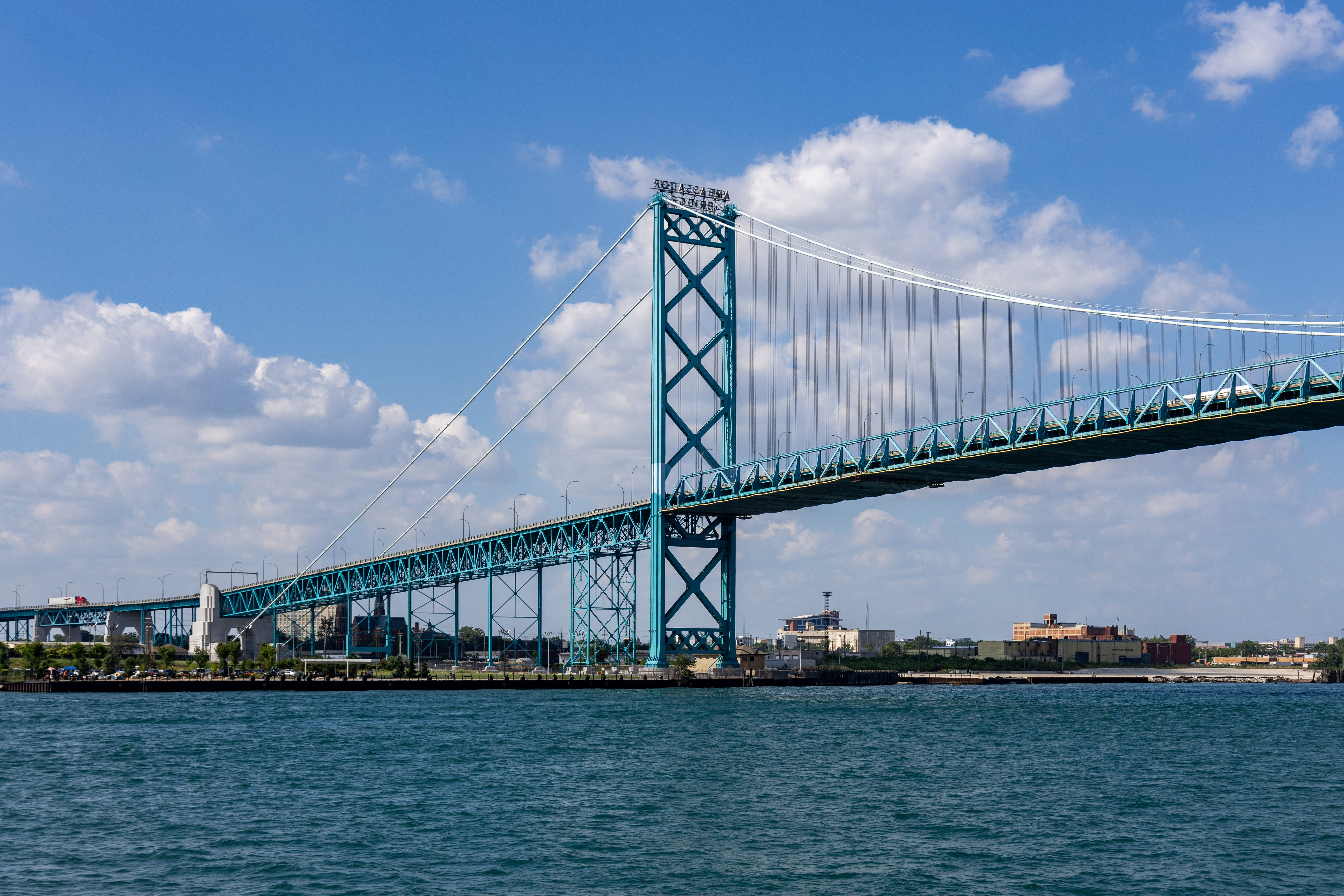
I filed formal comments opposing this. Based on federal routing-designation law, a study MDOT itself had commissioned, and decades of the company’s submissions and court filings, the record did not support granting it. The regulation MDOT was applying, 49 CFR Part 397, requires states to make an affirmative safety finding before granting this kind of redesignation. The record instead showed a private bridge company with a documented history of safety and maintenance problems asking to be trusted with corrosive and flammable freight over an international drinking water source. The timing wasn’t incidental either. The publicly owned Gordie Howe Bridge was already designed from the ground up to carry hazmat safely and was set to open within roughly a year, so MDOT’s approval let the Morouns beat the built-for-purpose alternative to market. Fire officials in Windsor raised the same concern about who absorbs the liability and emergency-response cost if something goes wrong mid-span. MDOT granted the redesignation anyway, on a six-month review, months before that alternative came online.
This wasn’t a headline decision Whitmer personally announced from a podium. It was a technical-sounding administrative action, made by an agency she appoints and controls, that quietly handed a politically connected private family exactly the outcome they’d been lobbying for since 2020, over the opposition of public health advocates, Canadian officials, and public comments in the docket, while the governor’s public-facing rhetoric stayed entirely about fixing roads and protecting communities.
FOIA: The Promise That Costs Nothing to Make and Nothing to Break
If you want the single cleanest measurement of the gap between Whitmer’s stated values and her actual conduct, it’s this: in 2018 she wrote, in plain terms, that “if the legislature won’t act, I will use the governor’s authority under the Michigan State Constitution to extend FOIA to the Lieutenant Governor and Governor’s Offices.” Michigan and Massachusetts are the only two states in the country that fully exempt the governor and the legislature from public records law. Whitmer promised to fix her half of that unilaterally, without waiting on anyone.
She has been in office since January 2019. As of the most recent tracking, that promise has gone unfulfilled for roughly 2,500 days, longer than the United States’ involvement in World War I and World War II combined. It gets worse than simple inaction. An internal memo from Whitmer’s chief legal counsel directs department and agency directors to notify the governor’s office when certain sensitive FOIA requests are coming in, so the executive office can be “fully informed” before disclosure, even though her office remains legally exempt from ever having to produce records itself. A leading open-government advocate called that memo “problematic” specifically because it adds a layer of review that can slow down requests to agencies she does have power over, while the governor’s office stays completely dark.
The bipartisan fix has passed one chamber or the other of the legislature in 2017, 2019, 2021, 2024, and 2025, and stalled every single time. Each time, Whitmer’s office has had the constitutional authority to simply extend the policy to herself by directive, at zero legislative cost, and each time she hasn’t.
Israel: The Unbroken Thread Since Day One
Whitmer’s first international trip as governor, in November 2019, was to Israel, hosted by the Jewish Federation of Metropolitan Detroit in coordination with the state’s economic development arm. It generated immediate backlash from the state’s Arab American community, whose leaders called it, per an Arab American News release at the time, an “insensitive and offensive trip to the apartheid state,” with a slap in the face feeling among many who had backed her a year earlier. Four years later, after October 7, she moved fast to declare herself “unequivocally supportive of Israel” after backlash to an initial statement critics found too vague. Now, in 2026, she’s endorsing the AIPAC-backed candidate in the Senate primary over the candidate AIPAC spent tens of millions trying to defeat.
Benton Harbor: Relief, but Only After Being Forced
Benton Harbor’s water started testing high for lead in October 2018. For three years, the response from Whitmer’s EGLE was to direct the financially struggling, majority-Black city to raise water rates to pay for fixes, while the underlying lead problem went unaddressed. My colleague Nick Leonard’s account of trying to work the system quietly is damning on its own: “A number of petitioners met with folks at EGLE in late 2019 to talk about things we thought were problematic with their response, and their answer at the time was, things are under control, lead levels are going down, we’ve got this.” They didn’t have it.
Nothing moved until September 2021, when GLELC joined nineteen other organizations, including the Benton Harbor Community Water Council, NRDC, Flint Rising, and the Michigan Environmental Justice Coalition, in filing a formal emergency petition with the EPA under the Safe Drinking Water Act. The petition asked EPA to find that Benton Harbor’s water posed “an imminent and substantial endangerment to the health of persons,” the same legal standard used in Flint. Leonard didn’t mince words about why it had come to that: “The EPA must exercise its authority to order delivery of water bottles and filters to Benton Harbor residents, schools, and day care centers; it is time for the federal government to step in to protect this low-income community of color from toxic water.” The petition also pointed out something uncomfortable: EPA had issued an emergency order for a mostly white West Virginia town with a smaller lead problem within months, while Benton Harbor waited three years.
Whitmer’s executive order came about a month after that petition landed. Credit where it’s due: once she acted, the follow-through was good. Nearly all 4,500 lead lines in Benton Harbor were replaced within a year, six months ahead of the accelerated schedule, and Leonard himself later called it “an incredible win.” Meaningful action from this administration tends to arrive only after the people harmed by inaction do the work of making delay politically unsurvivable while moneyed interests have little at stake.
If This Was the Audition, She Should Never Get the Lead Role
Whitmer says she isn’t running in 2028. She said it flatly at the Mackinac Policy Conference in May: “I will not be one of them.” Then, hours later, she corrected herself: “Never say never.” She’s since taken the vice chair job at the Democratic Governors Association, a post that exists to build exactly the kind of national donor and organizer network a future campaign would run on, and launched a Substack where her first post talked about offering the country “a path forward.” Whether or not she runs, this record is what “electable, moderate, gets things done” governance actually produces when you stop reading the press releases and start reading the permits.
A folksy Michigan accent and a “fix the damn roads” bumper sticker were never evidence of who actually gets protected when the money and the microphone show up in the same room. If the national audition is real, she should never play a leading role.